<?xml version="1.0" encoding="utf-8"?><feed xmlns="http://www.w3.org/2005/Atom" ><generator uri="https://jekyllrb.com/" version="3.10.0">Jekyll</generator><link href="https://liam-strand.github.io/feed.xml" rel="self" type="application/atom+xml" /><link href="https://liam-strand.github.io/" rel="alternate" type="text/html" /><updated>2026-04-27T20:23:41+00:00</updated><id>https://liam-strand.github.io/feed.xml</id><title type="html">Liam Strand</title><subtitle>So many nice things will be here one day.</subtitle><entry><title type="html">Finding Myself in Hamilton</title><link href="https://liam-strand.github.io/lit-blog/2018/05/23/finding-myself-in-hamilton.html" rel="alternate" type="text/html" title="Finding Myself in Hamilton" /><published>2018-05-23T17:40:00+00:00</published><updated>2018-05-23T17:40:00+00:00</updated><id>https://liam-strand.github.io/lit-blog/2018/05/23/finding-myself-in-hamilton</id><content type="html" xml:base="https://liam-strand.github.io/lit-blog/2018/05/23/finding-myself-in-hamilton.html"><![CDATA[<p><img src="https://static.wikia.nocookie.net/hamiltonmusical/images/5/54/103Lunges.jpg/revision/latest/scale-to-width-down/1000?cb=20161019135125" alt="picture of hamilton" /></p>

<p>You don’t have to know me for very long before you realize that I don’t back down from a fight. No, not physical fights, but cognitive challenges. I will sign up for more activities than I can manage, then carefully balance my commitments so that I can, if the stars all align, perform well in all arenas. This is not healthy, and I know that. But, I take a certain amount of pride in being able to churn through tremendous amounts of work in limited time. Of course, the more I overcommit myself, the more testy I get. I wouldn’t say that I get mean or grouchy, I just get a little sharp around the edges.</p>

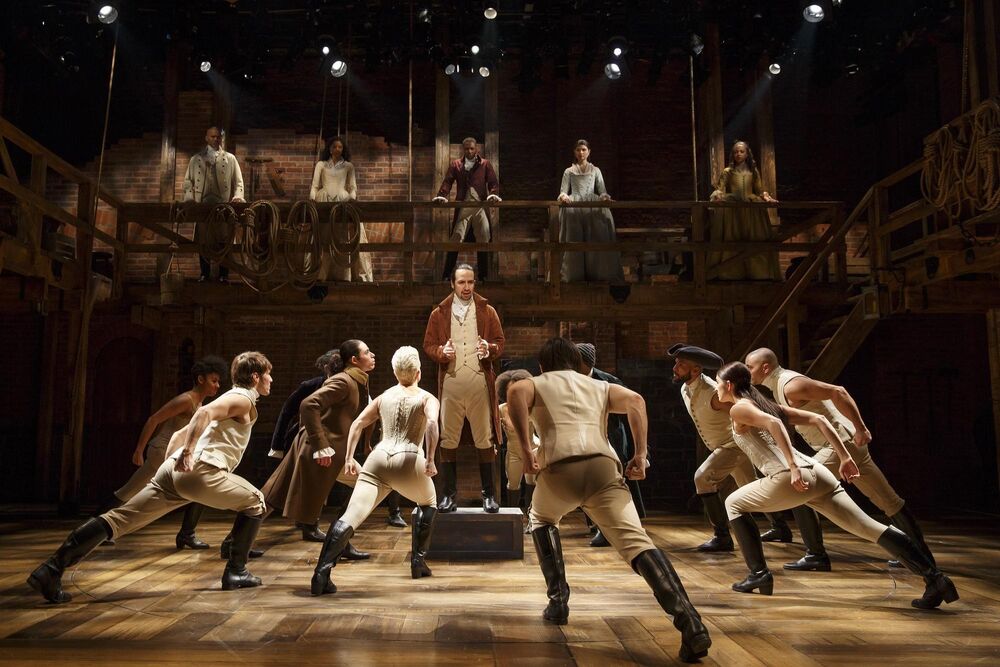
<p>In watching Hamilton, I see a little bit of myself in him, and a little of him in me. Instead of writing the planned 25 essays with John Jay and James Madison, Hamilton wrote 51 essays by himself in 6 months. It is this kind of drive to impress people that has driven me to some of my brashest decisions. For instance, my choice to stage manage Young Frankenstein, the high school musical this year. I knew that it was going to be difficult, but I had no idea how many hours would be required to make the show work. I won’t go into detail, but here’s a snapshot: me running music with my right hand, turning pages in my script with my left hand, cueing the stage crew through a headset and cueing the light board operator and the sound effects with head bobs. It was a stretch of my multitasking abilities, to say the least.</p>

<p>Of course, Hamilton is more than just a stress-ball of overcommitment, he is an immigrant, which I am not. After learning about Hamilton’s life, I have a newfound profound respect for immigrants who choose to come to America to make their mark, not just to survive. I would never have expected such genius to come from such a meager background. I suppose that prejudice is something I need to change in myself: I need to have a more open mind regarding where intelligence, wit, and drive can come from.</p>

<p>Another difference between me and Hamilton is that I am capable of holding my tongue; Hamilton, in a word, is not. The wonderful side-effect of Hamilton’s loose tongue is that there is a clear window into his consciousness. You will always know what Hamilton is thinking, regardless of whether or not you want to know.</p>

<p>Analyzing the character of Alexander Hamilton has enabled me to understand myself in a more nuanced way, recognizing the advantages and disadvantages of my personality traits. Knowing this, I will not only be able to realize when I am not utilizing my gifts, but also be able to see when my weaknesses are hindering my ability to work effectively and, more importantly, maintain relationships.</p>

<p>These kinds of personal realizations are the most important and engaging parts of literature, and are the greater purpose of literature as a whole. The goal of all literature is to show the reader another perspective and/or have the reader reflect on themself in order to inspire some sort of change; in attitude, action, or thought.</p>]]></content><author><name></name></author><category term="lit-blog" /><summary type="html"><![CDATA[]]></summary></entry><entry><title type="html">Hamilton: The Man and The Musical</title><link href="https://liam-strand.github.io/lit-blog/2018/05/08/hamilton-the-man-and-the-musical.html" rel="alternate" type="text/html" title="Hamilton: The Man and The Musical" /><published>2018-05-08T16:40:00+00:00</published><updated>2018-05-08T16:40:00+00:00</updated><id>https://liam-strand.github.io/lit-blog/2018/05/08/hamilton-the-man-and-the-musical</id><content type="html" xml:base="https://liam-strand.github.io/lit-blog/2018/05/08/hamilton-the-man-and-the-musical.html"><![CDATA[<p><img src="https://content.fortune.com/wp-content/uploads/2016/09/lin10_a.jpg" alt="" /></p>

<p><em>Hamilton</em>, the hit musical, has enthralled audiences and inspired Americans since its first preview in February, 2015. But why are people influenced by this musical?</p>

<p>Alexander Hamilton was born on a small island in the Caribbean called Nevis. Soon after he was born, his father left his mother to raise him alone, but she also died soon after. Hamilton was left an orphan without anyone to whom he could turn. He must have felt completely alone. As if his life had not already had enough hardship, a hurricane tore through the Caribbean, and left the entire island decimated. He used his gift of language to write about the hurricane and its effect on Nevis. People, both in the Caribbean and around America, were enthralled by his eloquence. He drew attention from some wealthy individuals who decided to sell a book collection to pay for Hamilton’s passage to the mainland.</p>

<p>Hamilton’s origin story is the quintessential American experience. One could even say that Hamilton was fulfilling the ultimate American Dream. He started from nothing and became a war hero, founding father, and the mastermind of the American economic system.</p>

<p>Let’s zoom in on just one example of Hamilton’s influence: his economic plan. Hamilton desperately wanted to wrangle the national debt into something manageable. He suggested that the US pay back its debts in full over time. In order to do this, however, Hamilton would need a line of credit into the US government, and a place to store that money. He proposed that the line of credit would be new protective tariffs, and the place to store the money would be the Bank of the United States. This economic plan shaped and defined how the American economy would operate for decades. It is impossible to overstate Hamilton’s impact on the American economic system.</p>

<p>Hamilton is a symbol of everything that is right with America. He had the opportunity to prove himself and use his vast intellect to make a positive change in the nation. He was the deciding factor in the election of John Adams, he was the strongest advocate for the founding charter of our nation, and he was an absolutely legendary soldier in the Revolutionary War. Seeing this kind of opportunity playing out in someone else’s life can give hope to audience members who might otherwise have forgotten about or given up on the American Dream.</p>

<p>People in America still have a sense of hope, of imagination, of self-improvement. Even though the realities of America limit people’s access to the American Dream, the idea of America is still an extremely hopeful one. The idea of America is why people are willing to give up everything to immigrate to America, to get a shot at the American Dream. The realities of America are complicated, confusing, disturbing, and dirty. But, that does not stop the idea of America from being beautiful.</p>

<p>In Mandarin, the character for the United States is 美国 (mei guo), the beautiful country. Many foreigners see America as a shining “city on a hill,” an example of what the world could be. Hamilton harkens back to that ideal by showing the audiences a clear example of someone fulfilling their American Dream in a fledgling nation.</p>]]></content><author><name></name></author><category term="lit-blog" /><summary type="html"><![CDATA[]]></summary></entry><entry><title type="html">You Have Power</title><link href="https://liam-strand.github.io/lit-blog/2018/04/04/you-have-power.html" rel="alternate" type="text/html" title="You Have Power" /><published>2018-04-04T18:10:00+00:00</published><updated>2018-04-04T18:10:00+00:00</updated><id>https://liam-strand.github.io/lit-blog/2018/04/04/you-have-power</id><content type="html" xml:base="https://liam-strand.github.io/lit-blog/2018/04/04/you-have-power.html"><![CDATA[<p><img src="https://inmenlo.com/wp-content/uploads/2018/03/SAcred-Heart-students-on-campus-1-300x225.jpg" alt="" /></p>

<p>Every year, a group of students at my school puts together a Student Justice Teach In, affectionately known as the SJTI. This event lasts a full school day and is exactly what it sounds like, a day devoted to teaching and learning about a specific aspect of justice. This year, the topic was violence. This topic was selected roughly a year ago. The leaders had no idea of the horrific acts of violence that would occur before the SJTI this year.</p>

<p>On February 14, an 18 year-old man brought an AR-15 into Marjory Stoneman Douglas High School and killed 14 students and three faculty members. The day before the SJTI was the one month anniversary of the shooting, and I chose to participate in a prayer service and walkout in the morning. Hundreds of thousands of students at over <a href="https://www.vox.com/policy-and-politics/2018/3/13/17110044/national-school-walkout-day">3,000 schools</a> walked out along with us.</p>

<p>The following day, at the SJTI, I learned a lot about violence. But, most impactful was the idea that all violence, whether it is physical, social, or emotional, stems from a mindset that seperates the world into “us” and “them.” Although, at first glance, this seemed like a huge and deep rooted change to make, it actually gave me hope. If we, as a society, can address this mindset, then it might be possible to stop the core cause of violence, rather than reactively addressing violence when it crops up. It will require more effort to change our mindsets than simply reacting to specific instances of violence. Addressing violence on a reactionary basis will never be enough to stop all violence. It is critical that we look at the bigger picture when we address this issue.</p>

<p>I believe that a change in mindset will be the most effective way to combat violence. But, how can we be expected to change the way we think about the people around us if our representatives keep thinking in the same old “us versus them” way? How can we change the political paradigm for our good?</p>

<p>We have to remember that our government exists to serve us, and the people who work there do so because we elected them, or someone who we elected appointed them. By design, our government gives us a ton of power, but only if use it. Our power is in our voices and our votes.</p>

<p>Even if there isn’t a presidential election, there are elections for local, state, and federal seats every year. The representatives who are chosen in these smaller elections are extremely important. Representatives in the State Legislature can enact regulations that you believe should be in place at a federal level. Mayors can adjust parking permitting laws that have a huge effect on your daily life. These down-ballot races are as important as the more publicized presidential elections.</p>

<p>By focusing so much on the presidential elections, we forget about the equally important local representatives who determine the laws, regulations, and codes that we all live by. And, if there is a local, state, or federal representative with whom you have a moral issue, the ballot box is the best place to make your voice heard.</p>

<p>Voting is the small nuisance that defines our democracy. It is a hassle to have to take time out of your day to go somewhere and decide who will be the best person to represent you. But, if we give up our votes, we are ceding our power to anyone who can be bothered to go to a poll.</p>]]></content><author><name></name></author><category term="lit-blog" /><summary type="html"><![CDATA[]]></summary></entry><entry><title type="html">The Wall</title><link href="https://liam-strand.github.io/lit-blog/2018/04/04/the-wall.html" rel="alternate" type="text/html" title="The Wall" /><published>2018-04-04T14:20:00+00:00</published><updated>2018-04-04T14:20:00+00:00</updated><id>https://liam-strand.github.io/lit-blog/2018/04/04/the-wall</id><content type="html" xml:base="https://liam-strand.github.io/lit-blog/2018/04/04/the-wall.html"><![CDATA[<p>I used to wonder<br />
About dreams and reality,<br />
I think the difference lies<br />
Between papers and illegality.<br />
<br />
I used to wonder<br />
About them and us,<br />
I think that is something<br />
We don’t really need to discuss.<br />
<br />
Now I wonder<br />
About that wall,<br />
And I ask myself<br />
Does it need to be so tall?<br />
<br />
Tonight I wonder<br />
As I lay in bed,<br />
If I’ll be next<br />
Or if my parents will be gone instead.</p>

<p><img src="/assets/images/wall-art-thing.jpeg" alt="" /></p>

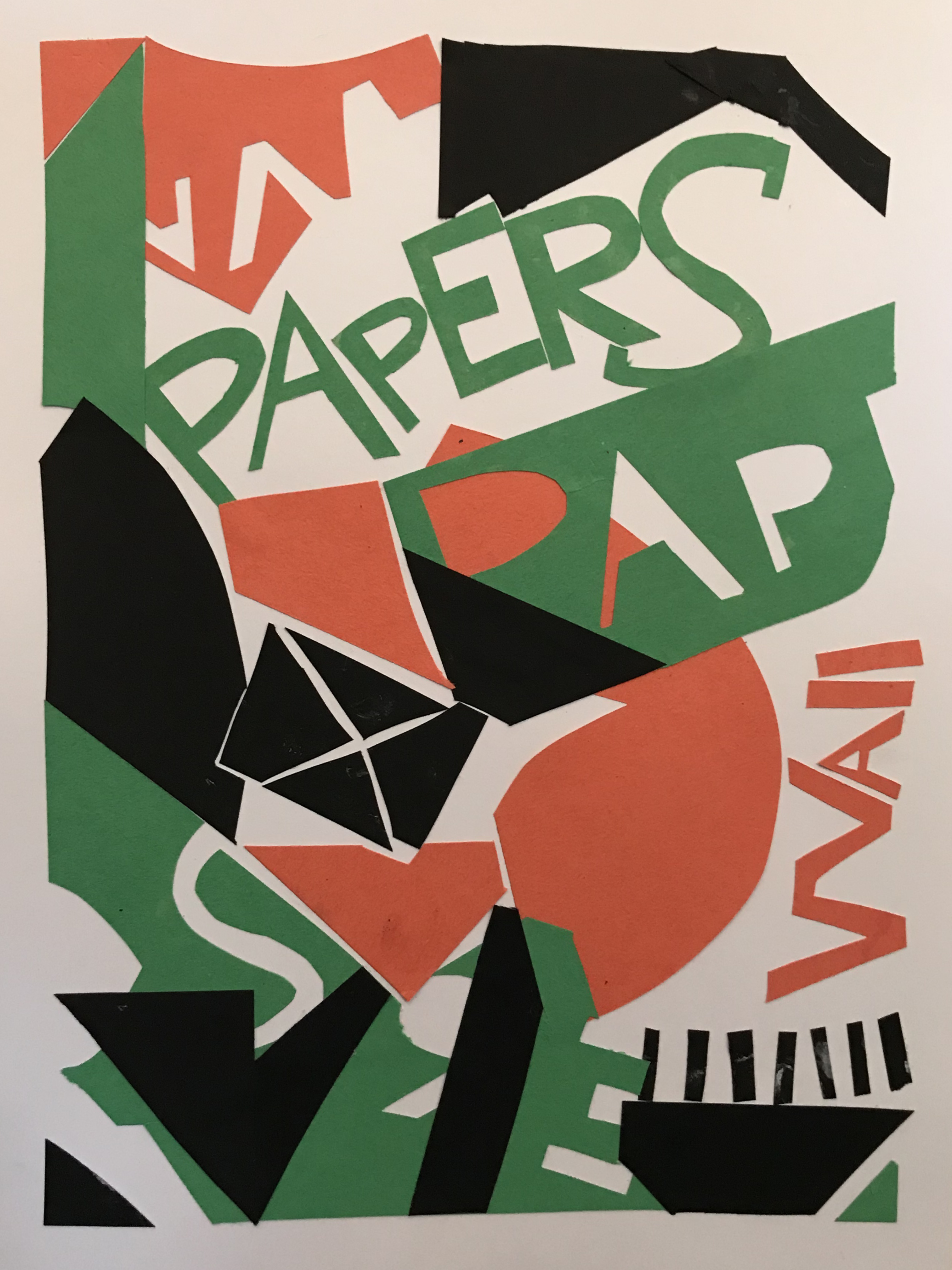
<p>To find inspiration for this poem, I simply flipped through my copy of <em>Selected Poems of Langston Hughes</em> to find a poem that struck me. I immediately saw “Border Line,” and reading it reminded me of the ongoing immigration crisis in America. I recalled the nearly 700,000 DACA recipients who live in constant fear of deportation because they trusted the US government to continue protecting them. Now, our government has walked back on that promise and is only one judge away from deporting the DREAMers en masse.</p>

<p>In my poem, I was sure to keep the same rhyme structure and questioning attitude as Hughes. I also tried to use some of his language to heighten the sense of confusion, discomfort, and terror felt by the speaker. I intend the audience of this poem to be any American. I hope that anyone who reads this poem comes away with a fuller understanding of the fear that DREAMers go to bed with every night, not knowing if, when they wake up, they will be ripped out of their home and sent to a country that they’ve never known.</p>

<p>My illustration also expresses this point with a jumbled mess of lines and shapes surrounding two words, “papers” and “wall”. There is often confusion and uncertainty as to what the future will bear. Will the speaker receive their papers and became a legal resident? Will the wall be built, symbolizing American isolationism and exclusion? Will the speaker get thrown out of the country altogether when they wake up in the morning?</p>]]></content><author><name></name></author><category term="lit-blog" /><summary type="html"><![CDATA[I used to wonder About dreams and reality, I think the difference lies Between papers and illegality. I used to wonder About them and us, I think that is something We don’t really need to discuss. Now I wonder About that wall, And I ask myself Does it need to be so tall? Tonight I wonder As I lay in bed, If I’ll be next Or if my parents will be gone instead.]]></summary></entry><entry><title type="html">The Importance of Honesty</title><link href="https://liam-strand.github.io/lit-blog/2018/03/03/the-importance-of-honesty.html" rel="alternate" type="text/html" title="The Importance of Honesty" /><published>2018-03-03T18:20:00+00:00</published><updated>2018-03-03T18:20:00+00:00</updated><id>https://liam-strand.github.io/lit-blog/2018/03/03/the-importance-of-honesty</id><content type="html" xml:base="https://liam-strand.github.io/lit-blog/2018/03/03/the-importance-of-honesty.html"><![CDATA[<p><img src="https://giphy.com/gifs/jay-gatsby-cUvHW8cyBSTjG" alt="" /></p>

<p>Jay Gatsby is many things, but he is not honest. He manufactured his entire personality the moment he met Dan Cody, leading to a lifetime of deceit and deception, he and Wolfsheim ran an unlawful alcohol distribution business during prohibition, he bought tens of thousands of dollars worth of books, but never read any of them, and he used his massive wealth to throw ragers so that Daisy would notice him. Even on the final day of his life, to show his love for Daisy, Gatsby takes the blame for killing Myrtle. All of these falsehoods catch up with Gatsby when he is shot by Wilson. After dying, it is clearly impossible to have a relationship with someone. But, even if he had lived, Gatsby’s lies would have eliminated any chance of him having a deep and intimate relationship with Daisy. Obviously, most instances of dishonesty do not end up with someone dead. But, where do we see this kind of behavior in the real world and how does it harm us?</p>

<p>Bella DePaulo, Ph.D. has done <a href="https://www.psychologytoday.com/intl/articles/199705/the-truth-about-lying">significant research</a> (in 1996) to determine when, and how often, people lie. She found that “most people […] lie once or twice a day—almost as often as they snack from the refrigerator or brush their teeth. Both men and women lie in approximately a fifth of their social exchanges lasting 10 or more minutes; over the course of a week they deceive about 30 percent of those with whom they interact one-on-one.” Of course, this is not the only study done on the ubiquity of lying; many of them show similar rates. Additionally, anyone who has spent any significant amount of time in America knows how much we lie. Just look around us, our politicians equivocate, our news organizations spin, and people cherry-pick statistics to prove their points.</p>

<p>There are two types of people who lying harms: the liar and the person being deceived. I’ll talk about the victim first. After being lied to, the victim often feels like they’ve been made out to be a fool. We see this most clearly in the characters of Tom and Wilson, who both do terrible things when they recognize that their reality is crumbling around them. In the moment of realization, the victim goes back and tries to understand how the liar could have done this for so long. One common reaction to discovering a major lie is to ‘poison’ all the memories that were affected by that lie. For example: if I had a longtime girlfriend cheat on me, I might look back on all the good times we had with disdain and disappointment, even though we would have had a great time together. Although it is possible that this sense of betrayal was a factor in Daisy’s ‘decision’ to abandon Gatsby and Nick, I doubt that her feelings were the deciding factor. I believe that Tom was so angry at Gatsby that he would have taken Daisy kicking-and-screaming if she had fought him.</p>

<p>But, lying doesn’t just hurt the victim, it also hurts the liar. <a href="https://health.usnews.com/health-news/articles/2012/08/20/how-lying-affects-your-health">A study</a> performed by University of Notre Dame (Indiana) professor Anita Kelly found that health measurably improved when people consciously changed their behavior to lie less. Kelly proposes that health improves because “telling the truth improves relationships […] and research has long indicated that people with good relationships have better physical and mental health” Another study, this one done by a professor emeritus at Loyola University named Linda Stroh, suggests that it is physically draining to maintain a lie for long periods of time.</p>

<p>Although Gatsby’s character was alluring and interesting, think of how taxing it must have been for James Gatz to maintain that persona for so many years. I believe that he must have felt trapped within his character. I know that I’ve had friends who’ve felt trapped by lies before, so I wonder where can we go to help for this? Well, there are several different crisis helplines (<a href="https://www.crisistextline.org">Crisis Text Line</a>: 471471, <a href="http://crisiscallcenter.org">Crisis Call Center</a>: 800-273-8255, etc), and all of them are free and anonymous. Finally, there is no shame in needing help, we all do sometimes. If family and friends aren’t helpful in this way for you, these resources are always available.</p>]]></content><author><name></name></author><category term="lit-blog" /><summary type="html"><![CDATA[]]></summary></entry><entry><title type="html">The Responsibility of the Wealthy</title><link href="https://liam-strand.github.io/lit-blog/2018/01/19/the-responsibility-of-the-wealty.html" rel="alternate" type="text/html" title="The Responsibility of the Wealthy" /><published>2018-01-19T16:40:00+00:00</published><updated>2018-01-19T16:40:00+00:00</updated><id>https://liam-strand.github.io/lit-blog/2018/01/19/the-responsibility-of-the-wealty</id><content type="html" xml:base="https://liam-strand.github.io/lit-blog/2018/01/19/the-responsibility-of-the-wealty.html"><![CDATA[<p><img src="https://howbeamerican.files.wordpress.com/2018/01/screen-shot-2018-01-07-at-7-27-12-pm.png" alt="" /></p>

<p>It is very easy to blame the poor for their situation: “they need to work harder,” “why do not they just go to school and get an education?,” and “it is not our job to help them.” I have considered these arguments in the past but, I have come to see that wealthy people, have a responsibility to use their money and influence to help those who are less fortunate.</p>

<p>In 2016, the <a href="https://www.census.gov/data/tables/2017/demo/income-poverty/p60-261.html">US Census Bureau</a> recorded that about 14% of Americans were impoverished. This means that there were roughly 41,000,000 people were unable to live on their wages. Meanwhile, the 1% most wealthy individuals possess 40% of the wealth of the United States.The “1%” would only have to give a miniscule percentage of their wealth to the bottom 14% in order to bring them out of poverty. But do not just take my word for it, here is the math:</p>

<ul>
  <li>The average income of the top 1% is roughly <a href="https://www.cnbc.com/2017/06/12/how-much-you-have-to-earn-to-be-in-the-top-1-percent-in-every-us-state.html">$1.15 million</a> per year</li>
  <li>There are about 320 million people in the United States, meaning that there are 3.2 million people in “the 1%”.</li>
  <li>$1.15 million per person per year × 3.2 million people = $3.68 trillion total per year</li>
  <li>It would cost <a href="http://www.gordoni.com/thoughts/wwit.html">$190 billion</a> per year to bring everyone out of extreme poverty in the US</li>
  <li>$190 billion  ÷ $3.68 trillion = 5.2%</li>
</ul>

<p>The 1% wealthiest people in the United States could end extreme poverty by allocating only 5.2% of their income to solving this problem. This may sound like a large percentage, but remember, this still leaves them with an average income of $1,090,625 per year, which most people would find to be plenty of money with which to live a lavish lifestyle.</p>

<p>I understand that it may not seem reasonable for many people to give up this percentage of their wealth to help others, but this investment in the least fortunate people in our society benefits everyone in lower taxes. The reason for this reduction in taxes is that the poor will not need to rely on welfare and entitlement programs to get their food, their healthcare, and their housing.</p>

<p>But, the more important reason to dedicate this funding to eradicating extreme poverty is that it is the right thing to do. The average income of someone in extreme poverty in the United States is $0.87 per day. Imagine that! $0.87 pays for about 1 minute of an education at my high school, and that is being generous. A quality education is critical for escaping poverty. Oftentimes, people are forced to work instead of attending school in order to afford the necessities of life.</p>

<p>By targeting donations at scholarship programs for private elementary, middle, and high schools in addition to <a href="https://howbeamerican.wordpress.com/2017/12/16/open-letter-on-student-debt/">four-year college programs</a>, people will “teach them to fish” instead of “giving them fish.”</p>

<p>Pulling people out of poverty is more than just a “nice thing,” it is a moral obligation.</p>

<p>If moral obligation isn’t enough to spur action, look at the financial benefits. Publicly funded scholarship programs have extremely high returns on investments, meaning that they MAKE the government (and by extension, the taxpayers) money. I explore this concept in more depth in my open letter about education.</p>]]></content><author><name></name></author><category term="lit-blog" /><summary type="html"><![CDATA[]]></summary></entry><entry><title type="html">Open Letter on Student Debt</title><link href="https://liam-strand.github.io/lit-blog/2017/12/16/open-letter-on-student-debt.html" rel="alternate" type="text/html" title="Open Letter on Student Debt" /><published>2017-12-16T14:50:00+00:00</published><updated>2017-12-16T14:50:00+00:00</updated><id>https://liam-strand.github.io/lit-blog/2017/12/16/open-letter-on-student-debt</id><content type="html" xml:base="https://liam-strand.github.io/lit-blog/2017/12/16/open-letter-on-student-debt.html"><![CDATA[<p><img src="https://live.staticflickr.com/5498/12343473805_0987598af1_k.jpg" alt="" /></p>

<p>Dear Senators Feinstein, Harris, and Beall; Congresswoman Eshoo; and Assemblyman Low,</p>

<p>I am a Sophomore in high school in the Bay Area. I am writing this letter because many of my friends and several members of my extended family have exited college with mountains of debt. I ask you to propose legislation that would help lower and middle class students pay for state college, and ensure that they don’t leave college with debt.</p>

<p>Currently, there are $1.45 trillion in U.S. student loan debt spread across 44.2 million Americans who, on average, each pay $351 towards their loans every month (“<a href="https://studentloanhero.com/student-loan-debt-statistics/">A Look</a>”). This makes it extremely difficult for students, fresh out of college, to begin their lives in the ‘real world.’ This affects underprivileged graduates especially, as they need to take out the largest loans and don’t have a monetary safety net provided by their parents. These underprivileged students are inexperienced, unprotected, and are often the first in their family to graduate from college. Upon exiting college, they are clapped with an average of $37,172 in debt (“<a href="https://studentloanhero.com/student-loan-debt-statistics/">A Look</a>”). It is extremely difficult for these students to pay off this much debt, and they often enter into a cycle of debt: taking out loans to cover the interest on other loans. This debt makes a college degree a burden, rather than a gift, to many graduates.</p>

<p>Eliminating college debt would also have substantial positive economic repercussions. If students leaving college don’t carry debt, they are able to save money more quickly, land better paying jobs, and pay more in taxes back to the government. Additionally, production would increase because educated people would be better utilized in the workplace, and not relegated to menial, monotonous jobs.</p>

<p>For a nationwide policy, with the burden of supporting students split between the state and federal governments, it has been estimated that the program would cost about $74.5 billion. That sounds like a lot of money, and it is. But, if you take into account the return on that investment in the form of more tax revenue and lower social services costs, the federal government would receive about $82 billion. That is a return on your investment of about 10%! How do the states fair in this? Over an average lifetime, state income taxes would increase by about $52,500 per four-year-equivalent (FYE) degree, meaning that for every FYE degree that the government funds, the government will make about $52,500 in tax revenue (“<a href="https://www.bostonfed.org/-/media/Documents/Workingpapers/PDF/economic/neppc/wp/2007/neppcwp0702.pdf">The Fiscal</a>”).</p>

<p>It would be immoral to disregard the massive socioeconomic benefits of debt-free college. It would be self-defeating to disregard the fact that “public financial support of college education pays for itself many times over” (“[The Fiscal]”). It would be unwise not to consider publically-funded, debt-free college as a legislative possibility. If you decide to pursue this course of action, you will be recognized as a hero to all of the college graduates who would have carried debt with them for the rest of their lives. Instead of being trapped in a cycle of debt, they will be free to prosper, all the while making more money for the government in the form of taxes.</p>

<p>Sincerely,</p>

<p>Liam Strand</p>]]></content><author><name></name></author><category term="lit-blog" /><summary type="html"><![CDATA[]]></summary></entry><entry><title type="html">The Crucible</title><link href="https://liam-strand.github.io/lit-blog/2017/11/14/the-crucible.html" rel="alternate" type="text/html" title="The Crucible" /><published>2017-11-14T16:40:00+00:00</published><updated>2017-11-14T16:40:00+00:00</updated><id>https://liam-strand.github.io/lit-blog/2017/11/14/the-crucible</id><content type="html" xml:base="https://liam-strand.github.io/lit-blog/2017/11/14/the-crucible.html"><![CDATA[<p><img src="https://howbeamerican.files.wordpress.com/2017/10/img_0151.jpg" alt="" /></p>

<p>Sometimes, when reading <em>The Crucible</em>, I feel like John Proctor is a hero (his final decision to sacrifice himself), and sometimes I feel like Proctor is evil (his treatment of Mary Warren). I attempted to act out a similar conflict while playing Rev. Hale, and I found it extremely difficult, which is why I am so amazed at the actor’s performance of Proctor.</p>

<p>He masterfully built up a strong and fearless character through the first act, then shocked the audience with his transformation into a broken man over the course of the second, third, and fourth scenes. His violent interaction with Mary Warren showed real fear that his wife would be accused. Later, in his meeting with Abigail in the woods, my classmate did a fantastic job of showing vulnerability yet also being firm and directive with Abigail. Showing two sides of the same character is a very difficult thing to do, and he demonstrated mastery in that skill in his performance. His breakdown in the courtroom and his final declaration that “God is dead” were captivating and displayed the ‘snap’ of his loss of self control.</p>

<p>His performance in the final scene, however, was nothing short of jaw dropping. He entered the scene as a scared, broken man. This is a stark contrast to the man who was in scene one. Contrasts like Proctor’s are extremely difficult to act out because it forces the actor to create two characters, and gracefully transition between them. The actor executed this transition with grace and precision. The most beautiful moment of the show, for me, was the final three lines of Parris, Hale, and Elizabeth. As a spotlight tightens on Proctor’s face, the audience hears Parris and Hale begging “Go to him Goody Proctor, take his shame away”. Then, Elizabeth declares, “He have his goodness now, God forbid I take it from him”, the music swells, and the spotlight goes out. The use of technical elements to illustrate the death of Proctor was an interesting choice of the director. I believe that a more graphic scene would have also worked, perhaps even more effectively. The shock tactic would have sent a strong message to the audience. But, showing a gruesome murder on a high school stage isn’t acceptable, especially since there were also younger kids in the audience. However, the technical elements were nearly as good, and made the play more reasonable for a high school audience.</p>

<p>One message of <em>The Crucible</em> has massive ramifications today. Too often we wall ourselves into our own echo chambers and refuse to listen to anyone from the outside. When we do this, we open ourselves up to the possibility of our prejudices and suspicions taking over and leading us to incorrect and dangerous conclusions, like the conclusions drawn in Salem.</p>

<p>This production of <em>The Crucible</em> also serves as a warning to the school community that conditions similar to the apparent witchcraft in Salem can still lead to outcomes like the unjust executions. Of course, the consequences of confusion in a school community would never be as severe as those in Salem, but overzealousness in response to pain can still lead to those on the fringes of the social order being pushed further out, while those in the center are drawn closer together. This warning is emphasized by the setting of the play in a high school in the future. It almost seems like the director was specifically warning my high school about what could happen to us if we aren’t careful.</p>]]></content><author><name></name></author><category term="lit-blog" /><summary type="html"><![CDATA[]]></summary></entry><entry><title type="html">The Impact of Community</title><link href="https://liam-strand.github.io/lit-blog/2017/10/22/the-impact-of-community.html" rel="alternate" type="text/html" title="The Impact of Community" /><published>2017-10-22T16:40:00+00:00</published><updated>2017-10-22T16:40:00+00:00</updated><id>https://liam-strand.github.io/lit-blog/2017/10/22/the-impact-of-community</id><content type="html" xml:base="https://liam-strand.github.io/lit-blog/2017/10/22/the-impact-of-community.html"><![CDATA[<p><img src="https://howbeamerican.files.wordpress.com/2017/10/img_0148-e1508701653286.jpg" alt="" /></p>

<p>I have spent nearly 120 hours preparing to perform <em>The Crucible</em> by Arthur Miller. This includes deciding on and learning blocking and inflection, creating the character of Reverend Hale, and of course, learning nearly 160 lines. Most people would be terrified of such a prospect, and to be honest, I was too. But, this fear is offset by the amazing community I have found in the theatre program.</p>

<p>When I was in 7th grade, you could not have paid me enough money to go onstage and act. I was introverted and pretty anxious. But, I enjoyed technical theater (lights, sounds, sets, props). So, I joined the group of other 7th graders who ran the technical elements of the 8th grade play (it was Peter Pan that year). I saw how much joy and kinship the rehearsal process and performances gave the 8th graders, and I knew that I wanted ‘in’ on that.</p>

<p>So, when the 8th grade play rolled around, I auditioned for the lead, knowing full well that it was extremely unlikely that I would get that role. I didn’t really want to be a lead, I just wanted to try theatre out to see if I enjoyed it. I ended up with one whole line “we do your majesty,” but I didn’t let that stop me from being involved in every aspect of the show. I moved nearly every major set piece over the course of the show, helped organize the motion of set pieces, props and actors during a complex rhythmic number called “Quiet!”, repaired a spotlight, and created a book documenting of all of the costume pieces and who was supposed to wear them when. By getting so deeply involved, I got to know people better and learned to be more extroverted, more carefree.</p>

<p>Fast forward to today: I’ve stage managed four shows and am now performing in my third show as an actor. Upon entering high school, I would have never expected to become so engrossed in theatre, but there is such amazing respect, camaraderie, and honest commitment to communal growth, that I found a community for myself. One experience stands out to me in particular: I was cast a significant role in Grease!, the first show of my freshman year. This was a huge surprise to me, because I was a very inexperienced actor. I really had no idea what I was doing. The other principal actors took me under their wing and taught me how to become a person onstage that I’m not in person.</p>

<p>But, there is such a thing as too much community, as exemplified in <em>The Crucible</em> (which is actually a true story). The people of Salem were so focused on keeping their community whole and safe, that they forgot to take a step back and see if their witch hunt was justified. The Salemites isolated outsiders and outcasts, making it nearly impossible for them to defend themselves against the accusations of witchcraft. It is likely that the accusers were only accusing the outcasts to save themselves, but self-defense is no excuse for what they did. The extremely tight-knit community also made it very easy for Abigail Williams to gain the trust of the community, because if one person believed her, then everybody believed her. The only people who suspected that Abigail was lying about the accusations of witchcraft were outsiders to Salem, John Proctor, Giles Corey, and Reverend Hale. John and Giles were not well-respected in the town; John for his lack of faithfulness, and Giles for his outlandish lawsuits. Hale was a stranger to Salem, so he had no affiliations in the town, other than being Parris’ friend.</p>

<p>There is nothing like that in theatre (at least in my experience). People are always welcome to new blood in the program. And, if someone isn’t living up to their potential, everyone works as a team to bring that person up. If there is a problem in the community, we work together to solve it, ensuring that everyone is allowed in the discussion.</p>

<p>I believe that theatre programs can serve as examples of communities that are open enough to allow new people in, yet tight-knit enough to help anyone out in a time of need.</p>]]></content><author><name></name></author><category term="lit-blog" /><summary type="html"><![CDATA[]]></summary></entry></feed>